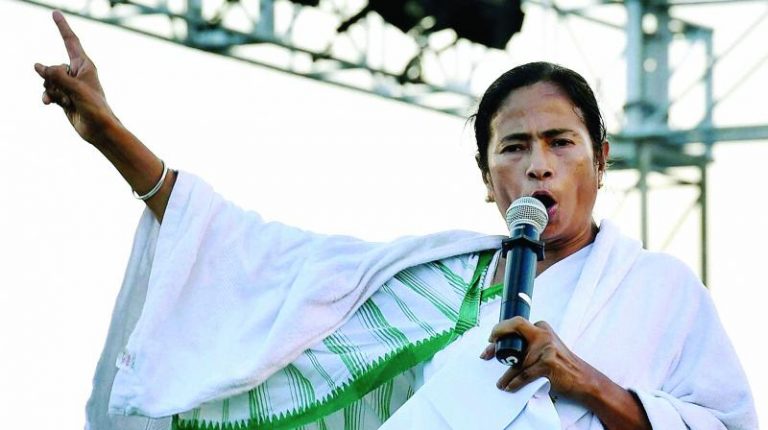
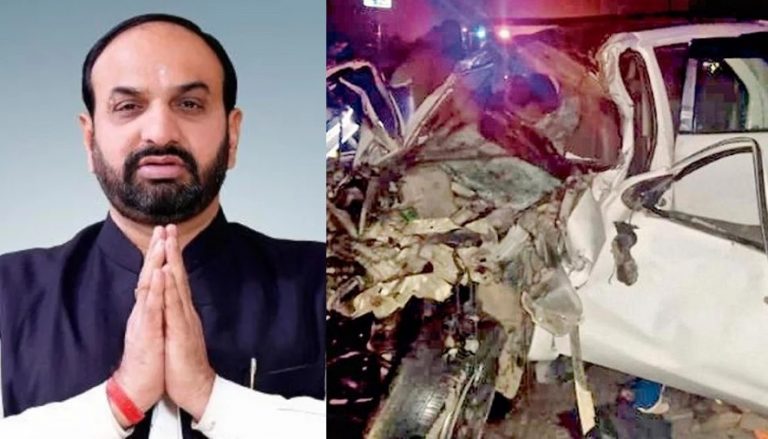
West Bengal Chief Minister and Trinamool Congress supremo Mamata Banerjee on Wednesday blamed the Modi government for the death of controversial Trinamool leader Tapas Paul.
Lashing out at the centre, Mamata Banerjee alleged that ‘pressure’ created by central agencies and ‘vendetta politics’ led to the death of Trinamool Congress leader and actor Tapas Paul.
“Central government’s pressure has claimed so many lives. Three people died due to this pressure by the agencies. Sultan Ahmed (former TMC MP), TMC MP Prasun Banerjee’s wife passed away and now Tapas Paul,” said Banerjee.
“People are being jailed but central agencies have not been able to prove their involvement or conclude what crime they committed. If someone commits a crime, they must face action. But we still don’t know what crime did Tapas Paul and others commit,” she added.
Banerjee also alleged that another TMC leader Sultan Ahmed had also died of cardiac arrest as he was under stress after being named an accused in the Narada tapes scandal of 2017.
Paul, a two-term former MP, died at the age of 61 in Mumbai on Tuesday after a heart attack. Tapas Pal had been a Member of the West Bengal Legislative Assembly from the Alipore constituency.
In 2016, Pal was arrested by the Central Bureau of Investigation (CBI) for his alleged involvement in the Rose Valley Chit-fund scam. The Ponzi scam had collected over Rs 10,000 crores as deposits from people in West Bengal, Tripura and Odisha.
The Bengali actor-politician was a board member of Rose Valley Marketing India Ltd and Idea Projects Ltd – two companies of the group – for brief periods over two financial years since 2009. Tapas Pal was granted bail after 13 months in imprisonment. Following his release, he had retired from active politics and refused to contest elections.
Paul had once threatened to get CPM workers killed and have their women raped if any TMC worker was attacked.
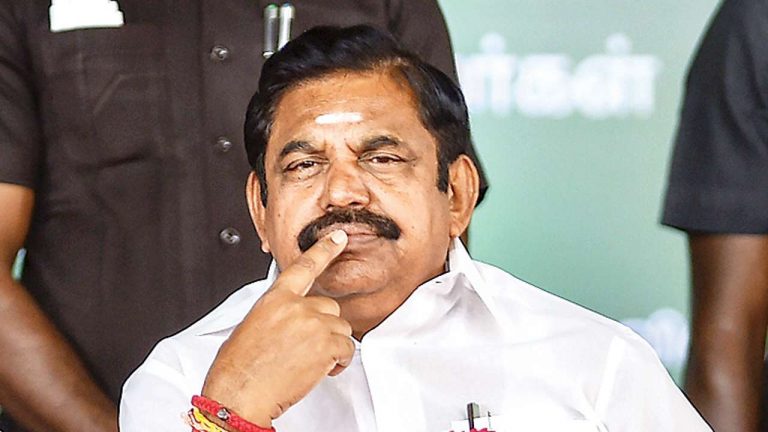
Coming in strong support of the Citizenship Amendment Act (CAA), Tamil Nadu Chief Minister Edappadi K Palaniswamy slammed the opposition party in the state Dravida Munnetra Kazhagam (DMK) for opposing it, asking them to show which community is affected by it. The CM said that the CAA would not take away the citizenship of any Indian, therefore, no Indian citizen will be affected by it.
Chief Minister EPS challenged the opposition in the Tamil Nadu assembly in response to DMK MLA Mano Thangaraj, who wanted the state to pass a resolution against CAA passed by the centre in the month of December 2019. Refusing the resolution, the CM said that DMK was misleading people by saying that CAA is against minorities, and asked them to show proof for that claim.
Mano Thangaraj had alleged that ruling All India Anna Dravida Munnetra Khazhagam (AIADMK) has submitted itself to the centre so they are not passing any resolution against Citizenship Amendment Act like other Indians states such as West Bengal followed by the communist state of Kerala.
EPS immediately intervened and said, “you have been saying this repeatedly and misleading the people of the nation. Who has been affected by this? Tell us? We will find a solution.”
Roaring in the Tamil Nadu assembly, Chief Minister EPS affirmed, “Point out and tell us which minority community person born in Tamil Nadu and living in Tamil Nadu has been affected. We will respond to it. Without doing that you (the opposition) are misleading the people, enacting a drama, spreading wrong information and have affected the peace in the state. Tell me, who has been affected. I will reply to that.”
The statement of CM EPS came following anti-CAA protests in Chennai. On Friday, anti-CAA protests in Chennai’s Washermanpet turned violent when a group of protestors clashed and pelted stone at the police injuring four police personnel including a woman joint commissioner, two women constables and a sub-inspector.
Earlier Superstar Rajnikanth defended the centre on Citizenship Amendment Act clarifying that CAA is not going to affect any Muslim if it does, then he’ll be the first one to stand for them.
On Tuesday, Maharashtra CM Uddhav Thackeray also defended the CAA, going against the position of allies Congress and NCP. He said that there is nothing to worry about as it does not apply to Indian citizens. He also said that NPR is just a census and there is nothing to fear about it also as it happens every ten years. He added that NRC has not been initiated by the central govt, and it will not be implemented in the state.
Citizenship Amendment Act was enacted in December 2019 which turned controversial when mass agitations and protest burst out in several parts of the country. The CAA proposes to give citizenship to six religious minorities of Pakistan, Bangladesh and Afghanistan through a process of Naturalisation.
India has seen the highest representation since 2015 in the list of the Times Higher Education’s (THE’s) Emerging Economies University Rankings 2020 with 11 Indian Universities making into the top 100. As per reports, this is the second time that 11 Indian Universities found their way in the top 100 list released in London on Tuesday evening.
A total of 56 Indian universities find a place in the full ranking of 533 universities from across the emerging economies of the world. Though it maintained its pole position among Indian universities, the Indian Institute of Science(IISc) slipped 2 levels in the overall ranking to 16th, followed by the Indian Institute of Technology (IIT)-Kharagpur and IIT-Bombay at 32nd and 34th positions.
In addition, Amrita Vishwa Vidyapeetham advanced a massive 51 places from a joint 141 ranking in 2019. THE has recorded improvements for Amrita University in almost all the ranking metrics, compared to 2019. It is notable here that the Amrita Vishwa Vidyapeetham was included in the ministry of HRD’s Institutes of Eminence scheme.
The Chief Knowledge Officer at the THE, Phil Bate remarked that for a long time now, there had been an enduring debate about the success of the Indian Universities in the world ranking and their underperformance on the global stage.
“The Emerging Economies University Rankings 2020 suggests that there has been tangible progress made by a large of institutions in almost all metrics across our robust methodology, and could herald an invigorating turning point for Indian higher education, partly empowered by the Institutes of Eminence scheme,” he said.
The other universities which have shown remarkable improvement in their rankings include IIT Delhi which rose by 28 places to joint 38th and IIT Madras moving up 12 places to joint 63rd. Entering the ranking for the first time, the Indian Institute of Technology Ropar and Institute of Chemical Technology too have debuted in the top 100.
China, with 30 universities in the top 100, has the most number of top universities in the list. A total of 47 nations are featured in the list.
The participating universities are provided with government funding and greater autonomy by the Institutes of Eminence scheme with the slated aim of bringing them into the top 100 of the world university rankings, including Times Higher Education’s World University Ranking.
The improvement in the ranking is planned by instituting a number of changes including an increase in foreign students and staff, providing online courses and promoting academic collaboration with other top universities around the world.
A day after former the news of former Mumbai police commissioner Rakesh Maria’s revelation that Lashkar-e-Taiba planned to project the 26/11 terror attack as a case of Hindu terror broke out, the BJP has launched fresh attacks on Congress, asking whether the ‘Hindu terror’ plot was the combined project of the Congress and Pakistan’s ISI.
Speaking to the media, BJP spokesperson GVL Narasimha Rao on Wednesday wondered if the ‘Hindu terror’ plot was a combined project by the Congress and Pakistani ISI. Rao said that there seems to be a connection emerging between Congress’ idea of Hindu terror and Islamic Terror group Lashkar, Pakistan’s spy agency ISI’s 26/11 strategy.
Questioning the Congress party over its ‘Hindu-terror’ plot, Rao asked whether someone from India was helping ISI as a handler to give Hindu identities to the terrorists. Targetting senior Congress leader Digvijaya Singh, Rao asked whether Singh was working as a ‘handler’ as he demanded answers from the Congress party.
BJP leader GVL Narasimha Rao: We can see a connection emerging between Congress’ idea of Hindu terror and LeT & ISI’s 26/11 strategy.Was someone from India helping ISI as handler to give terrorists Hindu identity?Was Digvijaya Singh working as handler?Congress should answer this. pic.twitter.com/cjOb3VQn8N
Earlier, Rao had added that Congress leader Digvijaya Singh had linked the 2008 Mumbai attacks with the Rashtriya Swayamsevak Sangh. “The fake identity proof of Ajmal Kasab and fake claims of Digvijaya Singh are not just coincidental resonance but seem to be part of a larger conspiracy,” he had said.
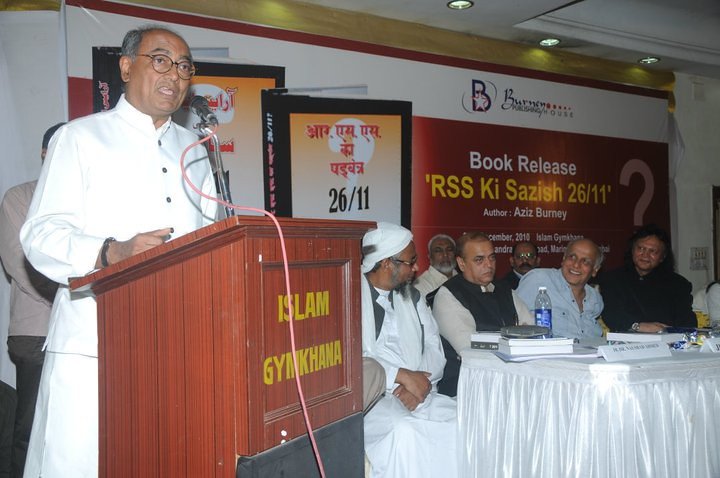
In 2010, months after the 26/11 Mumbai terror attack, Congress leader Digvijaya Singh, along with filmmaker Mahesh Bhatt and others had launched a book which claimed that the Mumbai terror attacks were an RSS conspiracy. While the world was holding Pakistan responsible for 26/11, then Congress general secretary Digvijaya Singh and close aide of Rahul Gandhi, had released the book “26/11 RSS Ki Saazish?” (26/11, An RSS Conspiracy?). The book was authored by Aziz Burney, Editor-in-Chief of Urdu Sahara newspaper.
Rao had claimed that Congress leader Rahul Gandhi had told United States diplomats that home-grown groups in India were a greater threat than Islamist terrorists operating from abroad. “The comments of Rahul Gandhi refer to 2007 and seem to have joint sponsorship of terror groups across the Line of Control,” Rao alleged.
In his book titled Let Me Say It Now, former Mumbai top cop Rakesh Maria has revealed that 26/11 terror attack convict Mohammed Ajmal Amir Kasab would have died as Bengaluru resident ‘Samir Dinesh Chaudhari’, with a ‘Kalava’ (Hindu sacred thread) tied around his wrist”, had the Lashkar-e-Taiba succeeded in its plans to pin the blame on Hindu extremists.
“There would have been screaming headlines in newspapers claiming how Hindu terrorists had attacked Mumbai. Over the top TV journalists would have made a beeline for Bengaluru to interview his family and neighbours. But alas, it had not worked that way and there he was, Ajmal Amir Kasab of Faridkot in Pakistan,” he writes in his book.
Union minister Piyush Goyal had attacked the Congress party on Tuesday, said, “I think it was a conspiracy by Congress, by the UPA. We have seen this before when Congress tried to impose the completely false ‘Hindu terror’ term at the behest of former Union Home Minister P Chidambaram”.
Adhir Ranjan Chowdhury, Leader of the Congress party in Lok Sabha, responded to Union Minister Piyush Goyal’s remark and said that there was a different background when ‘Hindu terror’ word was coined. Chowdhury claimed that the term ‘Hindu terror’ was coined during the Mecca Masjid blast case and the arrest of Pragya Thakur in Malegaon blast case.
Defending the Congress party on their failed conspiracy theories to implicate RSS, Chowdhury added, “Terrorists always camouflage. They do not carry out attacks with their actual identity. It was the UPA government which revealed everything about the attack. Ajmal Kasab was later hanged during UPA rule.”
For over a week now, Indian liberals have been pleading, almost begging, with Kejriwal to show some solidarity with their favorite ‘secular’ causes. They are pleading with him to go to Shaheen Bagh, meet students of Jamia Milia Islamia, say a word of support for Sharjeel Imam and what not.
But Arvind Kejriwal is unflappable. The man who once delighted Pakistani hearts by questioning surgical strikes has been walking in lock step with the BJP on all issues that have to do with ‘nationalism.’ Until the election in Delhi, liberals admitted they understood his compulsions. But now that the results are out, they want him to drop the act and join hands with Shaheen Bagh. Liberals are convinced that Kejriwal’s heart is with them.
Unfortunately for liberals and their sinking hearts, the Delhi CM is giving them a lesson in realpolitik like no other. Here is what AAP is actually busy doing.
AAP MLA Saurabh Bharadwaj announcing recital of Sundar Kaand in Greater Kailash constituency
Hindu votes matter. Welcome to 2020.
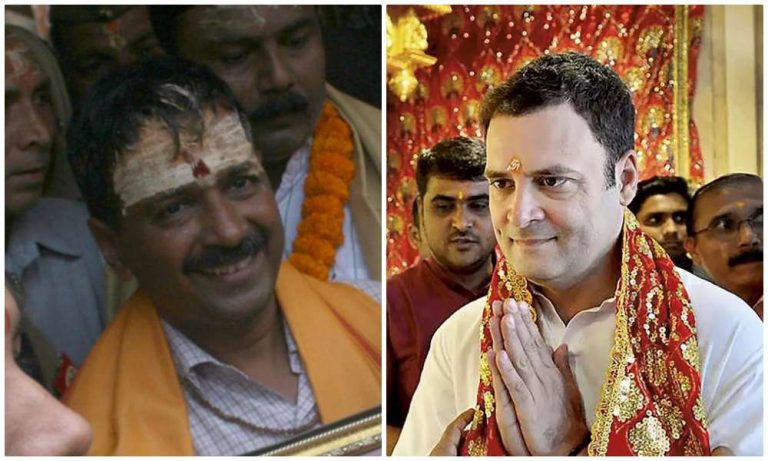
On the landscape of Indian politics, everyone seems to be doing the same thing. Kejriwal recites Hanuman Chalisa on demand. Mamata Banerjee shows off her ability to remember a host of Hindu mantras. Rahul Gandhi can’t stop visiting temples. Even the inexorable Communists are said to be considering steps that will give their outdated party a Hindu makeover.
Everyone on the Hindu right seems to be enjoying the turn of events, with the ecosystem on its knees before a newly unified Hindu voting bloc. But opinion is divided over the long term real impact of a ‘soft Hindutva’ opposition.
On one side, there are those who see much good coming of this. A democracy runs on two wheels, not one. With the opposition getting on the Hindu bandwagon, the “center” shifts towards the Hindutva. It also exerts rightward pressure on the BJP to deliver even more substantially on core Hindutva concerns.
Then there are those who worry that the current rightward shift is too opportunistic. That it might give Hindus a false sense of political security. And once the Hindu wave subsides, “secularism” will quickly bare its fangs.
Both sides are right in their own way, but I would say the concerns are overblown. Yes, the ‘soft Hindutva’ from the opposition is an act, a desperate choice made under pressure of circumstances. To us, it may seem like an act, but so what? In politics, perception is reality. And perception soon turns into reality.
Let us dissect this. It is easy to get too involved with ourselves and forget that the present moment is not everything. That we are constantly being replaced by younger generations. The electorate is constantly being replenished with new generations who are walking into a very different political landscape than what we remember. In the epic of India’s destiny, our lives are but a speck.
So we notice the transition because we were very much around to see it happen. At least, it is still fresh in our memory. We remember Kejriwal’s politics from four years ago. Does everyone? In fact, who remembers Kejriwal from his supposed anti-corruption avatar and Anna Hazare movement? That was in 2011! It’s about to be ten years. In this Delhi campaign, did you hear Kejriwal even say the word corruption?
He chose to stop talking about corruption and picked up free bijli-paani as his main political act. Over the years, the act became a reality. The life of most politicians and most political parties is a succession of such deliberately chosen acts. And that is pretty much all that matters.
Similarly, if the opposition now wants to walk into the Hindu mold, there is little cause for alarm. The act will soon become a reality. Younger voters will not know anything else. And older voters will gradually forget the earlier times. As a net result, India’s politics will evolve towards the Hindu right.
We can look back and see just how true this is. The UPA government from 2004 to 2014 can only be described as “hardline anti-Hindu.” This is the government that openly said that Muslims would have the first right to India’s resources. They conspired to crush Hindu institutions with the RTE. They dreamed up the Communal Violence Bill, which would hold Hindus responsible for every act of sectarian violence in India. They floated the Hindu terror theory. Even when actual terror attacks happened, many of their leaders would fan conspiracy theories about Hindu terror.
But for the Congress, the hardline anti-Hindu stance was also an act, a considered choice. Who remembers that Rajiv Gandhi began his election campaign from Ram Janmabhoomi in Ayodhya? Indira Gandhi was never averse to harnessing soft Hindutva for the sake of winning elections. The Indian constitution has a drawing of Purushottam Ram on its most important page, at the beginning of Part III where the Fundamental Rights are listed. Imagine if such a thing were suggested now. The extended Congress ecosystem would start convulsing with hatred. Today, they can’t stand a train berth that is symbolically reserved for Lord Shiva for just one day. Not even an Om symbol drawn by hand on the side of the Rafale.
The Congress was convinced that its narrow win in 2004 was purely due to consolidation of ‘secular’ votes. And when they won bigger in 2009, they became certain that hardline anti-Hindu was the way to go!
That’s how they picked up this act. And then the act took over them and became reality.
The same phenomenon can be seen in other spheres. Only the other day, there was a flutter on social media because some liberal comedian thought that cities of Delhi, Agra and Amdavad were all built by Mughals.
How come they did not know the Hindu heritage behind these cities? Surely the Hindus who were around when these places were conquered and subjugated were aware of the heritage. But that was hundreds of years ago. The generations that came later simply forgot.
This is why labels matter. Changing the name of a city may not feel like much. A political party picking up a new act may even seem like bluff. But it makes a huge difference some years down the line. When Bombay was renamed, most people still called it Bombay. For a while. Now everyone says Mumbai.
The Congress may not be the main opposition for much longer. It looks all set to cede its position to a clutch of regional parties. And these regional parties increasingly want to be seen as Hindu in their outlook and identity. Many of these regional leaders will pass their parties down to their kids. The culture of these parties will change forever. If India manages to keep its Hindu demographics, the conscious and opportunistic choice by certain parties to “act Hindu” today will ultimately prevail over the entire political culture. And nobody will remember anything else.
Two Delhi politicians were killed in a gruesome road accident in Uttar Pradesh. The accident took place near Kanpur on the Lucknow-Agra Expressway on Monday (February 17, 2020) in which a total of 6 people were killed. Surjeet Singh and Vikram were amongst the politicians who had fought the recently concluded Delhi Assembly elections. Surjeet fought as an independent candidate against Delhi’s Deputy Chief Minister and Aam Aadmi Party strongman Manish Sisodia.
Lucknow-Agra Expressway accident: 6 killed in collision as bus driver falls asleep while driving#expressway#Lucknow
According to the reports, Surjeet, the founder of a Delhi-based Sai temple, went to Pratapgarh in Uttar Pradesh with his companions on Sunday to attend a wedding function. The following day, after concluding his meeting with a UP minister, when he was returning to Delhi by car at night, his car was hit by a Bihar roadways bus. 6 people were killed in the collision as the driver of the Volvo bus fell asleep, lost control of the bus which crossed the road divider and rammed into Surjeet’s Toyota Fortuner SUV which was coming from the opposite side.
Among the 6 killed, 4 were travelling in the car, while two were on the bus, including the driver. 15 passengers on the bus were injured in the accident. The Volvo bus was a private bus attached to Bihar State Road Transport Corporation, which was going to Muzaffarpur district.
Surjeet had fought elections against Delhi Deputy Chief Minister Manish Sisodia. Manish Sisodia, who fought from Patparganj, barely scraped through the victory in the Delhi Assembly elections with the winning margin just over 3000 votes. Independent candidate Surjeet, however, managed to get a paltry 215 votes only. Another deceased Vikram had contested from Trilokpuri assembly constituency. He had floated a new political party- Janashakti Party (National) and fought on its ticket. However, he too couldn’t enthuse the voters to vote for him. Vikram only managed to get a meagre 259 votes. Aam Aadmi Party won this seat and BJP candidate Kiran finished second.
Surjeet Singh was a former corporator from Bahujan Samaj Party from Mayur Vihar, Delhi. He is survived by his mother, two wives, three children and three brothers. Surjeet left the BSP and joined the BJP in the Delhi Municipal Corporation election 2017. He was in a continuous association with the BJP but because he was denied an election ticket, he had filed his nomination for the Delhi elections as an independent candidate.
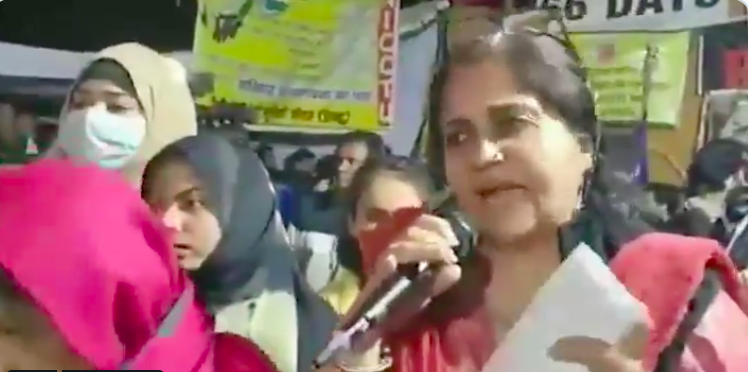
BJP IT cell head Amit Malviya today shared a video on Twitter wherein ‘activist’ Teesta Setalvad, who has been earlier accused of embezzling 2002 riot victims’ money, appears to be tutoring Shaheen Bagh ‘protestors’ on what questions to ask the Supreme Court appointed interlocutors.
Teesta Setalvad tutoring Shaheen Bagh protestors on what questions to ask the interlocutors, appointed by the Supreme Court… See how organic and spontaneous this movement is? pic.twitter.com/gsZCBS5l0t
In the 2-minutes long video, a lady can be heard reading out a list of questions the women could ask the interlocutors appointed by the Supreme Court to mediate and convince the Shaheen Bagh protestors to relocate to an alternative place. Teesta Setalvad could be spotted right behind her overseeing the tutoring.
The first question that would be put forth is whether the change in protest venue would weaken the protest. The lady in pink then explains that these are the questions they’ll put forward and they don’t need to answer them. Second question is who will take responsibility of safety of the women protestors. The third question would be what do the Shaheen Bagh ‘protestors’ have to say about the difficulties people are facing because of road blocked by them. Teesta then interjects and explains that the ‘difficulties’ here is like the difficulties related to traffic and other inconveniences. The fourth question would be whether opening half the road help. The next question would be if the elements of the Shaheen Bagh protests are changed, will it weaken the protests.
Teesta then asks the ‘protestors’ if they are satisfied with the questions. The woman in pink then explains how one of them will sit with women in group of 25-30 and explain in detail. Later Teesta explains what exactly change in elements of protests means.
When questioned about Setalvad’s presence at Shaheen Bagh tutoring the ‘protestors’ as per Times Now, Shaheen Bagh spokesperson reportedly lied and claimed that this is an old video and has nothing to do with Supreme Court appointed interlocutors. Shockingly, Shoaib Jamei, denied on air that Setalvad was present at the venue on Tuesday.
He even went on to claim that Setalvad was not even in Delhi’s Shaheen Bagh when it is extremely clear that she was there. Later, the organisers at Shaheen Bagh did accept that Setalvad was indeed present at venue last evening and was ‘discussing’ these questions.
#TeestaTutorsShaheen | EXPOSED: The latest video of @TeestaSetalvad tutoring the Shaheen Bagh dadis is not an old video as claimed by the Shaheen Bagh spokesperson.
Moreover, an image captured earlier yesterday also shows Setalvad entering the venue.
Setalvad’s controversial history
Teesta Setalvad’s troubles root from an alleged 1.4 crores funds embezzlement case against her and her husband. She had allegedly collected funds for the 2002 riot victims and instead used it for personal luxury and expenses. The allegations had come to light after one of the residents of the Gulbarg Housing Society filed a complaint against her alleging that she had embezzled funds collected for the 2002 riot victims through her NGOs Sabrang Trust and Citizens for Justice and Peace.
On Monday, a 2-Judge Bench of the Supreme Court comprising of Justices Sanjay Kishan Kaul and KM Joseph directed senior advocates, Sadhana Ramachandran and Sanjay Hegde, to act as interlocutors and convince the Shaheen Bagh protestors to relocate to an alternative place. The order came at the backdrop of two petitions filed in the apex court, seeking clearance of Shaheen Bagh area and the Kalindi Kunj Road. It is notable here that lawyer Sanjay Hegde has been caught spreading fake news several times. After Twitter suspended his account, he had even stated that he will take Twitter to the international court.
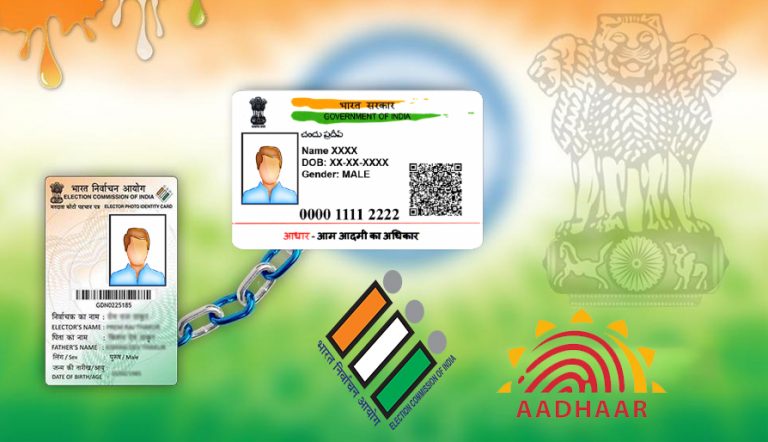
The union government has decided to amend the Aadhaar Act to legally empower the Election Commission to link the unique identification number with the electoral roll, aiding them to remove bogus and duplicate entries. The new reform will also pave the way for giving “remote” voting rights to migrant voters, reports Times of India.
According to the reports, the law ministry is working on the proposal to be put up before the Union Cabinet for approval in the coming weeks as it would require amendments to the Representation of People’s Act (RPA), 1951. The new process, apart from sanitising the electoral roll, will save internal migrants from “disenfranchisement” by changing the current practice, allowing them to vote only if they are in the constituency where they are registered as voters.
The Law Ministry has conveyed this to the Election Commission at a meeting on Tuesday. Chief Election Commissioner Sunil Arora, along with Election Commissioners Ashok Lavasa and Sushil Chandra met Law Secretary Narayan Raju and on Tuesday to discuss the pending electoral reforms.
At the meeting, Chief election commissioner Sunil Arora stressed on the need for the law ministry to fast-track implementation of reforms proposed by the Election Commission and urged to hold regular discussions with the EC to review progress.
Reportedly, Law secretary Narayan Raju has assured the poll panel that the ministry was examining the 40 electoral reforms proposed by the EC and that each was at a different stage of discussion.
On seeding of the electoral photo identity card (EPIC) with the 12-digit Aadhaar number, the law secretary said the government was favourably inclined and a Cabinet note would be moved soon to amend the Aadhaar Act.
The EC officials said Aadhaar-EPIC linkage will help realise the ECI plan to work towards secure, possibly electronic, voting to help migrant voters — including domestic workers, migrant labourers etc — exercise their franchise.
“Their identification having been adequately verified, the commission can explore technology that will let them vote from a remote location guarded by the EC,” an officer said.
In 2015, the ECI had taken up linking of voter card and Aadhaar number as part of its National Electoral Roll Purification and Authentication Programme. Around 32 crore Aadhaar numbers were seeded by the time. However, the EC decided to abandon the programme in view of the Supreme Court judgment restricting the use of Aadhaar.
Following the SC judgment last year allowing the mandatory collection of Aadhaar with a due amendment in the Aadhaar Act, the EC had written to the law ministry seeking an amendment to enable linking of EPIC with Aadhaar. The law ministry had in-principle agreed and a Cabinet note is being prepared.
In a letter to the Ministry of Law in August last year, the EC had stated it would be in the “national interest” to link Aadhaar with voter IDs to cleanse the electoral rolls and prevent duplication of voters. The EC had also asked the ministry to make necessary legal amendments for the linkage.
On Tuesday, several media reports claimed that the Hyderabad Regional Office of the Unique Identification Authority of India (UIDAI) had sent notices to 127 people to ‘prove their citizenship’ after it had found that they had obtained Aadhaar card illegally.
The media had reported that the UIDAI had served notices to certain citizens to appear before an inquiry officer as the office has received complaints/allegations against them that they are not citizens of India and have obtained the Aadhaar card through ‘false pretences’. They have been asked to appear before an inquiry officer on February 20 at a function hall in Balapur, the reports said.
“UIDAI sends notice on ‘illegal’ Aadhaars”, reported Deccan Chronicle.
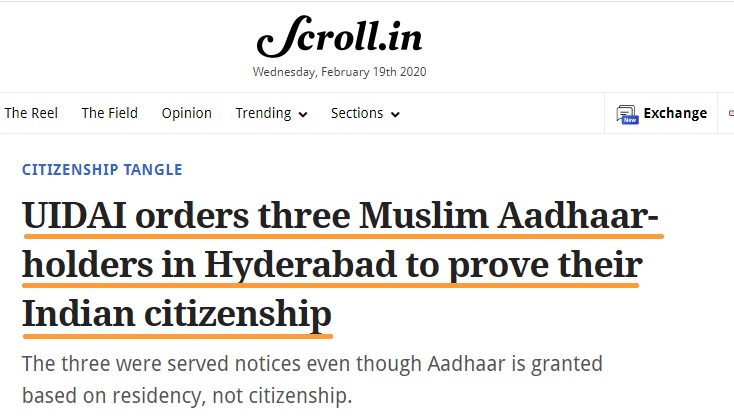
Left-wing news outlet – The Scroll, which has a history of peddling fake news, went a step further to communalise the issue as it reported that UIDAI had ordered three Muslim Aadhaar-holders in Hyderabad to prove their Indian citizenship.
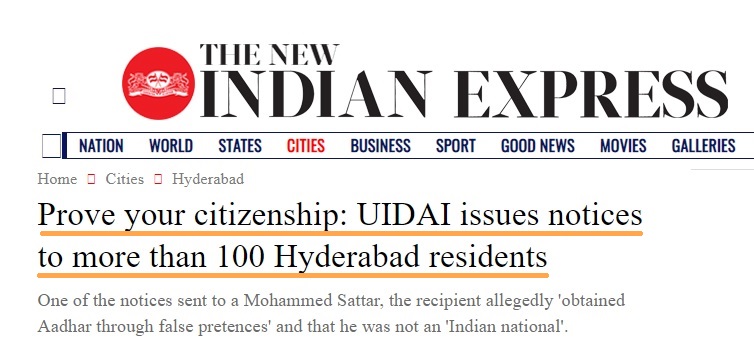
The New Indian Express also reported the same incident with a headline stating, “Prove your citizenship: UIDAI issues notices to more than 100 Hyderabad residents”.
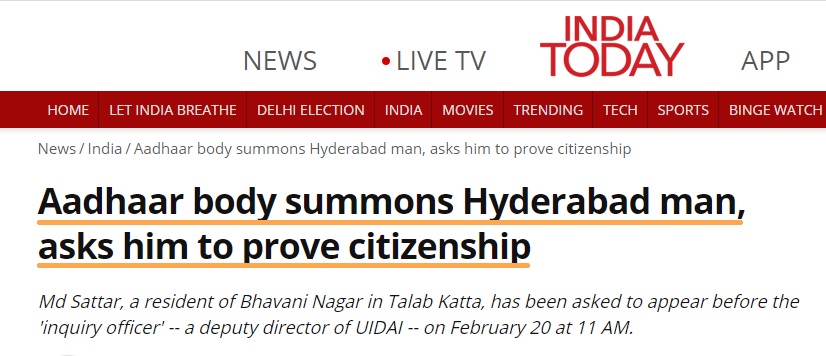
India Today, which has been lately receiving severe criticism over fake sting operations and deliberate disinformation campaign, also reported that Aadhaar authorities had summoned a man in Hyderabad and asked him to prove his ‘citizenship’.
Following the outrage, on Wednesday, the UIDAI clarified that the news reports which had earlier reported that 127 people were sent notices for allegedly obtaining Aadhaar numbers on “false pretences” has got nothing to do with the citizenship.
In a series of tweets, the UIDAI clarified that they have not summoned people to check their claims of citizenship as Aadhaar is not a document to prove citizenship.
There are news items in certain section of media regarding UIDAI issuing notices of inquiry to some residents for obtaining Aadhaar on false pretence on the complaints from the State Police which suspect them of being illegal immigrants. 2/n
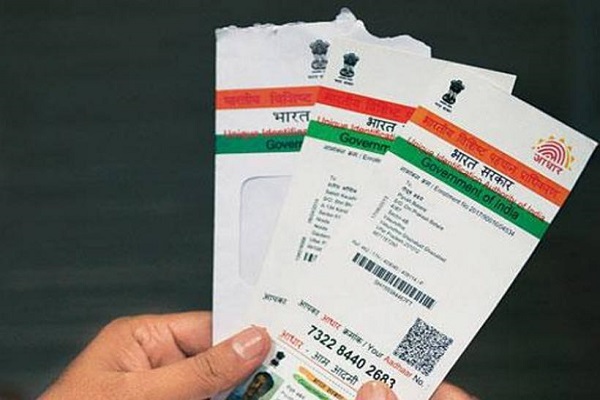
“Aadhaar is not a document of citizenship and UIDAI has been mandated under the Aadhaar Act to ascertain residency of a person in India for 182 days prior to applying for Aadhaar,” the nodal body, which issues the 12-digit biometric ID, said UIDAI in a tweet.
The UIDAI citing news reports said, “It may be noted that the regional office Hyderabad received reports from the state police that 127 people have obtained Aadhaar on false pretences, as in their preliminary enquiry they were found to be illegal immigrants who were not qualified to obtain an Aadhaar number,”
As per the Aadhaar Act, such Aadhaar numbers are liable to be cancelled, it added.
“Therefore, the regional office Hyderabad has sent notices to them to appear in person and to substantiate their claims for getting an Aadhaar number,” it said.
The UIDAI emphasised that these notices have “nothing to do with citizenship and cancellation of Aadhaar number is in no way related to the nationality of any resident”.
In case it is found and proved that any of them obtained Aadhaar by submitting false documents or through false pretences, their Aadhaar is liable to be cancelled or suspended depending on the severity of the transgression, UIDAI said.
“Severe errors like forged documents, etc., will lead to appropriate actions, including suspending /cancelling the Aadhaar,” it cautioned.
“Sometimes it becomes necessary to cancel the Aadhaar number when it is found that a resident has obtained it by submitting false biometrics or documents. It is a routine quality improvement process that the UIDAI takes up regularly,” the authority said.
The 127 people have been asked to appear before the UIDAI deputy director in Hyderabad for a personal hearing on February 20. Additional time has been given to allow them to collect the required documents,
“Since it may take them some more time to collect the original documents that they had submitted for obtaining Aadhaar, as informed by the state police, the UIDAI has postponed the personal hearing to May 2020,” it added.
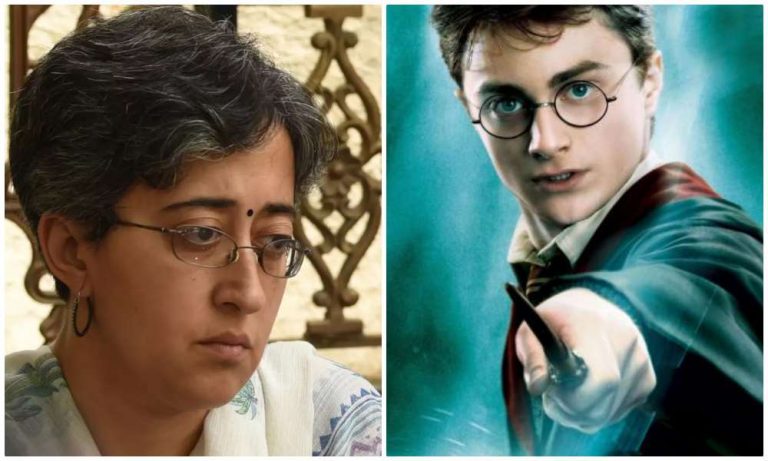
A week after Arvind Kejriwal-led Aam Aadmi Party came back to power with a landslide victory, newly minted MLA Atishi Marlena took to Twitter to share an endearing anecdote involving her niece and Netflix. Marlena shared how she was ‘negotiating’ with her niece about what to watch on the online streaming platform Netflix when her niece insisted they watch Harry Potter.
Negotiation with my 12-year old niece about Netflix
Niece: Masi, let’s watch the last Harry Potter movie
Me: मुझे कुछ और देखना है
Niece: MLAs को जनता की बात सुननी पड़ती है
The witty ‘niece’ quipped that the MLA must listen to ‘janta’ and hence Marlena relented. The duo watched Harry Potter on Netflix. However, there is one issue. Netflix does not stream the popular series.
Netflix does not have Harry Potter series
Netizens were quick to point out this little discrepancy in Marlena’s tweet.
Netizens also wondered if she had cooked up the whole story to appear funny on social media.
So she has manufactured a scene to sound funny on social media. @AtishiAAP Mam harry potter is not on Netflix. You are suffering from Mythomania. And your surname is quite right too in this situation. https://t.co/wLLWCizWvK
Marlena had earlier contested 2019 Lok Sabha elections against BJP’s Gautam Gambhir where she lost. While she had been portrayed as education reformer in Delhi’s government school, Arvind Kejriwal has conspicuously kept her out of the newly constituted Delhi cabinet.